
The care with which and also a fountain
by Steven Chodoriwsky with Maddie Leach
We dragged the image to the right—it became nostalgia; we dragged the image to the left—it became critique.
— Lisa Robertson, “The Middle”
The beginning
I’m filing a dispatch about Support Structures from Salt Lake City about Lund—two places outside of much international news. It is about a large-scale public artwork on the Lund University of Technology (LTH) campus, officially titled Utan titel (“Untitled”), built 1969, known colloquially as The Fountain (Fontänen), and it is also about Maddie Leach, artist, born 1970, with whom I’ve been corresponding, who has been undertaking a multi-year research project called The Fountain: an art-technological-social drama.
But even from my initial proposal to Support Structures to write this brief note, to contacting Leach, to the time it takes to write brief notes to her within longer periods of time, bombarded with other missives to write brief notes, or make school lunches, or conduct classes, or sleep, to the time it takes to wrangle schedules across time zones to speak to her, not to mention the strictures of funding deadlines or for granting reports due, to the inevitable crunches brought on by calendars and academic years, it turns out that the Fountain, and the Fountain’s story, have undergone new developments, and depending on who you ask, commonplace ones, or consequential ones, or both, changes that alter one future and foreshadow another.
“Considering you’re in the middle of it—”
“I feel I should be more—I’m inching my way toward the middle of it!”
In other words, it is business as usual in the realm of public art, campus, systems, and landscape, and the long durations that bear upon the labor of research. Our ongoing dialogue, conducted in Fall 2024 over phone calls and text messages, threaded the extensive history of the Fountain with the foreground of yesterday’s fieldwork; threaded speculative thinking with red tape, threaded solid facts with spun yarns. “I’m happy to have the proximity to be following it. The next stage is to see them painting it…”
Commissioned by the Swedish Public Art Agency in 1967 for LTH’s Faculty of Engineering and constructed in 1969, the Fountain was designed by architect Klas Anshelm and the artist Arne Jones. Eighteen steel columns rise from uneven earth, and together with radiating spokes hold up square canopies at several heights. These once held up glass boxes for a reserve of water, which would cascade down in ribboned arcs from canopy to canopy.
In an Instagram post Leach offers up Anshelm’s “hairy” concept sketch, three-quarters mastodon, with that hubristic simplicity of form patented by high modernists. An art historian noted its diagrammatic resemblance to hogweed; elsewhere, its looming campus presence is labelled “a monstrosity.” Why not provide automobile parking on top, asks a tongue-in-cheek drawing from a 1971 issue of LTH student publication Litet Ordo—the perfect “combination of two useless systems.”
In over a half-century it has weathered threats of demolition, failed inspection reports, public debate, derisive nicknaming, and the occasional coat of paint or a shearing of its undergrowth. In 1996 student activists saved the Fountain from a full dismantling, and helped negotiations to instead honour its stature and substance—but nevertheless bid farewell to its water supply. Supporters offered it speeches on a late summer day, raised glasses and downed drinks (presumably), before workers arrived to demolish the glass boxes and turn off the tap. An enactment of rites both informal and pragmatic prepared the Fountain, suddenly fountainless at twenty-seven-odd years, for a murky convalescence.
Seen from above, its siting seems to featherstitch up circulations (it intercepts a campus walkway) and landscapes (it looks like a portage between two small bodies of water). Squint and from middle distance and it may appear like a conference of hydraulic lifts. Leach mentions Anshelm’s desired campus plan, never executed, of a series of identical buildings encircling the Fountain, a pet project of sorts, which would be this “cathedral of glass and steel, inspiring technology students about what could be done.”
Techno-optimism and charismatic form aside, it also represented a passion project by local old men. Viola Robertson, a critic at the time in the Sydsvenska Dagbladet, called it the “ugly hulk,” and above all denounced its lack of due process. “It should have been an open call for artwork in relation to the building project—but Anshelm got to do what he wanted. He invited his good friend [Jones] and they got more money than had ever been spent on a public artwork. It was absolutely an inside job!” A loophole that skirted common practice had become an “artistic statement” with a charismatic form, in a key location, for a growing university. As far as boondoggles go, it’s become more of an eccentric footnote with time—but it’s still a stitch in the state’s side. The Fountain’s ongoing upkeep has cost so much that it has been called the miljonfontän; the irony is not lost on Leach that her research funding, from the same state sources, might add a million more.
Moving image
Systems betray, or are, as in a “made place,” made betrayals.
— Lyn Hejinian, My Life
Sculpture outdoors often exceeds its own materiality and location through representation. They travel through the world as photographs, postcards, as backdrops for events. These rumours create charismatic sculptural fictions that always disappoint.1
— Lisa Le Lefeuvre
Leach—New Zealander, Swedish resident, artist, educator, researcher—came to the Fountain almost accidentally in 2018, became fascinated, used it as a test case at a grant writing workshop, and emerged with a batch of well-tempered paragraphs. In 2020 this became a successful proposal to a national call about how policies around “building-related public art” might be reimagined, mediated, and managed beyond their restoration or demolition. She enfolded comrades (architect Lars-Henrik Ståhl, theorist Cathryn Klasto, writer Mick Wilson— “solid companions, voices to speak to; they bring thoughts, but they also have different interests”) to expand the “problem” of the Fountain as this conspicuous, complex character lesson in the designed living environment, equal parts cultural fixture and administrative nuisance. “The agencies chose us because we were one of the few with a public art perspective, and Sweden has a highly prolific public art industry. There are projects constantly emerging and landing everywhere—city levels, regional levels, government levels, private levels. I managed to re-start the narrative of this fifty-five year old artwork, enough to capture an imagination around it. We’re not renovating or rebuilding—but is it possible to do something else?”
But the deeper the study goes, the less smoothly specifics may apply elsewhere. There’s a slippage between one-off and prototype, and one arrives at conundrums about scope, resolution, and reproduction. It seems important that Leach draws from drier scientific reads like “Driving forces behind organisational changes in water supply in South Sweden 1950-2010” by Kenneth M Persson and Jörgen Johannson. Archival sources, or texts in general, can go from slushy to riveting and back again, depending on their reader and their grounds for knowing.
Research becomes a quiver of caretaking tactics as Leach, present and local, shifts from guest to host and back. “The research has allowed… an addition to the archive,” she suggests tentatively, complicating the idea that she’s designing a protocol for evaluation that is easily replicable. “What can we apply to future thinking about commissioning public art works?—well, that’s a life long project.”
Meanwhile, Leach is developing a moving image of the Fountain, playing with its levels, casting it as a character. The maintenance and distribution of its image is tethered to the physical artifact, pulling it this way and that. What if it crops up here, in this scene or construction detail. What if it disappears behind an overgrowth of vegetation or a trail of paperwork. What happens when a passerby enters the frame just long enough to tape a Free Palestine poster to its central column and then darts off to class. What about when new lighting along the path hikes its contrast, steel frame gleaming white against a black sky. Perhaps campus safety improves; perhaps the Fountain appears garish, exposed. Bring it to the foreground of awareness, and a kind of nostalgia creeps in, playing up the quote-unquote destiny of this location and a heroic sculptural form. But what about when water blasting, painting, and the “required maintenance” of its owners eliminate every trace of patina, every build-up of lichen, collapsing it into a time-less present.
Or pull the shot way back, where no relief is stark, and see the educational systems within profit-seeking systems, themselves amid municipal agencies and regional hydrological systems. Lund’s water supply managers have run a stormwater channel right under the Fountain’s feet, connecting it to its two adjacent ponds, itself connected to a smart system of advanced forecasting that mitigates the risks of extreme weather events.
Naming and caretaking
The care with which the rain is wrong and the green is wrong and the white is wrong, the care with which there is a chair and plenty of breathing. The care with which there is incredible justice and likeness, all this makes a magnificent asparagus, and also a fountain.
— Gertrude Stein, “Tender Buttons”
After much conversation with Leach, and as is often the case with people whose company I enjoy, I still have very little sense of what she actually does. Because how she practices appears enmeshed in the motions between things, it is difficult to separate this from that. “As for movement,” in a paraphrase of Lyn Hejinian describing Gertrude Stein’s writing, Leach works “to understand things not in isolated rigidity, which falsif[y] and monumentalize conditions which [a]re fluid, but as present participants in ongoing living—outpouring, fountainous living.” We catch her oscillating between an infrastructural intervention and a research intervention.
“I’m trying to track the movements of its name in various media articles, from names as basic descriptions—what it’s made of—to names as characters, as figures. Officially it’s called Untitled. At its simplest it’s called Fountain, or Fountain Sculpture, or Water Sculpture, then Fountain in Glass and Steel, or Water Art. Other times it’s referred to as a sort of forgotten child who hasn’t been adopted. It’s been called a Frankenstein-like object, then it’s a Sleeping Beauty. Or laxtrappan—the salmon ladder. Also Dead Falls.” And as many names as the Fountain has inherited, Leach rhymes off as many monikers for what an artist’s position to public artwork could, or should, be. “We tried caretaker or custodian; we discussed differences between fostering and adopting. At other points we liked contract”—but also that has these bounded, business-based connotations. “So—what to call it? It’s more than proposing just a dossier for future maintenance.”
As though channeling stormwater, in 2023 Leach solicited a community of local informants and international enthusiasts, had them descend on Lund, and drew them into the legible form of the academic symposium to discuss the Fountain’s afterlives. A workshop asked attendees to construct a “Memorandum of Understanding,” wading further into how stewardship works, with systems of governance, property and tradition in its path. “Are we saying that artists, through our training, could speak for, or on behalf of, artworks? We edge into slightly shamanistic territory, characters of care…” Leach’s attunement to shifts in fiscal, social, and historical landscapes feels delight-centered, mischievous. She plays out the what-ifs in the flow of radical kinship with the Fountain, somewhere between interspecies camaraderie and legal advocacy.
I propose to her the very Swedish notion of being the Fountain’s ombud, thinking alongside Trinh T. Minh-Ha’s sense of “speaking nearby”: for the register of complaints, for the resistance to compliance, for remaining close, tarrying even, for moving at pace with, but not at the behest of, bureaucracy, with an ear for local language, an eye for new turns of events, a nose for the perverse, a shoulder to the elements, a knack for disentangling.2 For harnessing setbacks and easements, for singing triumphs and disappointments, equally and alike.
The middle
I’m trying to get rid of the affliction of being in art. Why not introduce a new curriculum? A course of plumbing or electrical work.
— Alexander Melamid
Leach’s work in ever expanding circles around the Fountain suggests that an act of research itself can be a support structure: a scaffolding that mediates and advocates for its subject of study. In the middle of all this, however, is Leach’s original artistic impulse: “The project began, essentially, with the possibility to reimagine another artist’s work by installing a small water tap onto the central column.” It’s a pitch-perfect intervention. All of Leach’s complex plumbing around authorship, agency, and infrastructure would culminate in a single machined fixture, the slightest gesture. Naively I picture it exactly like the graphic from the Water Works space in the board game Monopoly:
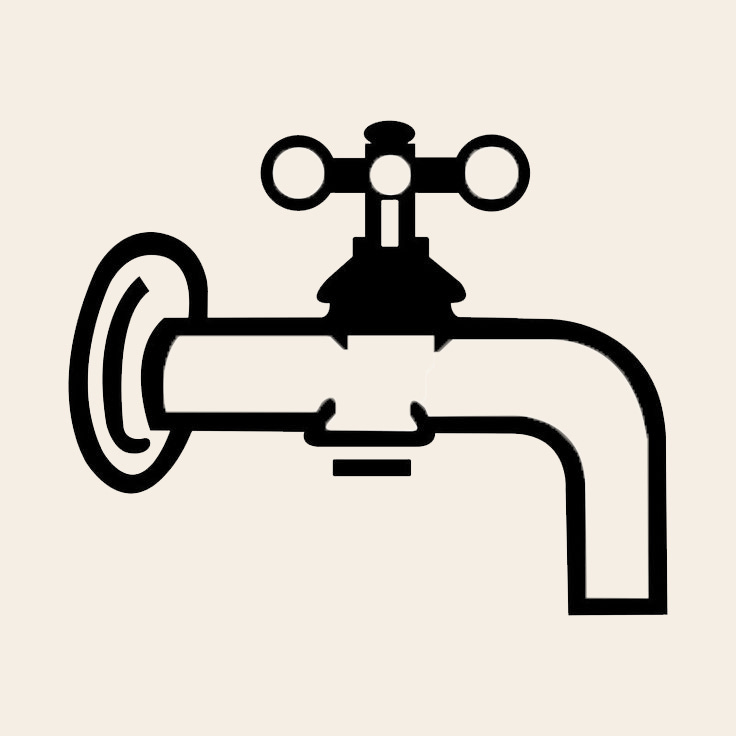
The proposal works not to serve the flow of capital or grease the wheels of policy but blithely, cheekily, it asks the Fountain’s owners to commit to something like a sprung leak. Leach’s own surname may point to irrigation—a rerouting of discussion, or the supplying—supplication?—of a system from a replenishable source.
Infrastructural developments around the Fountain have not only rerouted Leach’s research trajectories, but potentially elbowed into her own artistic move. “The problem is, it will have undergone something before I will have had the opportunity to make my own case.” And the campus and its assets move on their own standard time, with the polyrhythm of academic calendars colliding with distinct seasons and their maintenance schedules, which collide in turn with fiscal deadlines or administrative decrees, which prompt seemingly knee-jerk waves of activity, activating in turn a spreadsheet behind password protection, a memorandum, a work order. Suddenly they’re sandblasting clean the delicate patina of a decade’s worth of lichen build-up. A site that seemed so murky, snaps back to something heavily administered, measured, and surveilled. Is the Fountain still the same Fountain?
“I can still propose it of course, and I want to…” she hesitates. “But does it merge with all that’s going on around it? Does it manage to maintain a distinct gesture?”
At the ordained conclusion of the funding period Leach will receive five minutes of a committee’s time to report on findings from a sprawling, multivalent, methodically-paced epic of a story, recommendations on what do next, and—most importantly to any committee—what lessons might be learned so that their vast portfolio of state-administered building-adjacent public art might be more effectively stewarded.
Does the Fountain deserve pinning to the spot at least as long as a standing stone? Or, maybe relocated to a pasture, with other displaced state holdings, to collectively convalesce in open air? Or, if demise is imminent, at least mercifully by force majeure, rather than by a banal force d’Excel-lence?
The committee recommendation, however, is no iceberg tip, no beginning nor end, just another middle. She’s now working on a book which is circling back through all her work to foreground an intimacy, a relationship. “It’s moved from the standard expectation of research output, like organizing a symposium, to incorporating other voices and companion artworks, to writing a report—to just being something that captures something—just a book, just me, and the fountain.”
Perhaps in a future biopic of the above scene we will see Leach advocate before the chair of a committee, and after a few silent nods, he will rise from his seat and proclaim, “Yes. We are pleased to announce that the review of applications for a new fleet of ombudspersons för byggnadsanknuten offentlig konst is now underway nationwide, open to artists and citizens of all stripes, and that the positions, while still in the process of being fully articulated, are available, effective immediately, or in due course.”
While no traditional anniversary jubilee, 2050 will mark the start of the Fountain’s fourth twenty-seven-year period; fountain fans, campus pundits, and obscure numerologists would do well to book their tickets to Lund. “Watch this space,” Leach laughs, leaving enough time between each word to let it mean multiple things at once.
Steven Chodoriwsky is a designer, artist, and educator. His research-centered practice engages with performance and interdisciplinary platforms, pedagogical models, and speculative acts of reading and writing with the built environment. He is Assistant Professor in the Division of Multi-Disciplinary Design at the University of Utah. @e____d___i__t_s
Maddie Leach is an artist from New Zealand now based between Lund and Gothenburg in Sweden. She is Senior Lecturer in Fine Arts at HDK-Valand Academy of Art & Design in Gothenburg and holds a PhD from Deakin University in Australia. Educated in sculpture, Maddie has sustained a commitment to new forms of public art and site-based practice over a 25-year career. She is currently working on a research project about a failed public artwork on the campus of Lund University in southern Sweden. @thefountain_fontanen @maddieleachartist
This quotation is from Le Feuvre’s presentation at the public symposium Fountains Failures Futures: The afterlives of public art, held at the Lund Skissernas Museum in 2023.
The litany, the commas, the ingredient list without quantities, the rhythms of repetition: I can remember where the rhetorical technique impressed upon me, and since then I’m always on the lookout for variations: it is from Celine Condorelli’s epic book project Support Structures (2009), lovingly designed by James Langdon, which starts with an extended list of what the book—and what support—is for (and perhaps arrives full circle at Andrea Dietz’s own ambitious project of the same name):
for what bears, sustains, props, and holds up […], for those things that encourage, give comfort, approval, and solace; that care for and provide consolation and the necessities of life […], for that which assists corroborates, advocates, articulates, substantiates, champions, and endorses; for what stands behind, underpins, frames, presents, maintains, and strengthens.